AI Chatbot for eCommerce: How Enterprise AI Chatbots Increase Sales, Conversions, and Customer Support Efficiency

Priyanka Wadhwani
Shopping cart abandonment is currently at 70.22%. This implies that three out of four shoppers abandon the purchase after adding goods to their carts. This results in huge losses measured in trillions each year. However, some enterprises are still making use of static FAQ pages or bots that use a predetermined set of rules for answering clients' questions.
There is a wide gulf between client expectations and actual experience. An AI chatbot bridges this gap not through automation but by providing clients with an always-on, context-aware, and interactive assistant that knows everything about your inventory and the intent of customers.
A client engaged in an interaction with an AI chatbot will convert 12.3% of the time, while one that does not is only converting at 3.1%.
In this guide, we look at the difference between the AI chatbot for eCommerce and widget; explain how chatbots can increase sales, productivity, and efficiency in business; and determine important criteria in the selection of an enterprise-level AI bot.
What is an AI Chatbot for Ecommerce?
An AI chatbot for eCommerce business involves a conversational software layer that works on top of your website, mobile application, and other messaging services. It analyzes the intent behind questions asked by users, extracts information on products, inventory, and orders in real-time, and provides answers in ways that help buyers make progress.
An enterprise-level AI chatbot employs advanced technologies such as LLMs, NLP, and contextual memory to have actual dialogues with your audience. The main distinction lies in flexibility. A typical bot fails when the user poses a question differently.
A conversational AI chatbot for eCommerce businesses at the enterprise level tolerates vagueness, keeps track of dialogue flow, switches from product search to purchase-related support in a single conversation, and escalates to a human operator with context preserved.
Enterprise-level eCommerce teams working with AI chatbots in production have stopped following a passing fad and started creating a stable source of income.
Why Enterprise eCommerce Needs More Than a Basic Chatbot
Basic chatbots rely on narrow scripts, leading to workflow failures and measurable revenue loss for mid-market and enterprise retailers. In contrast, an enterprise AI chatbot is an integrated, omnichannel system built for high-volume transactions.
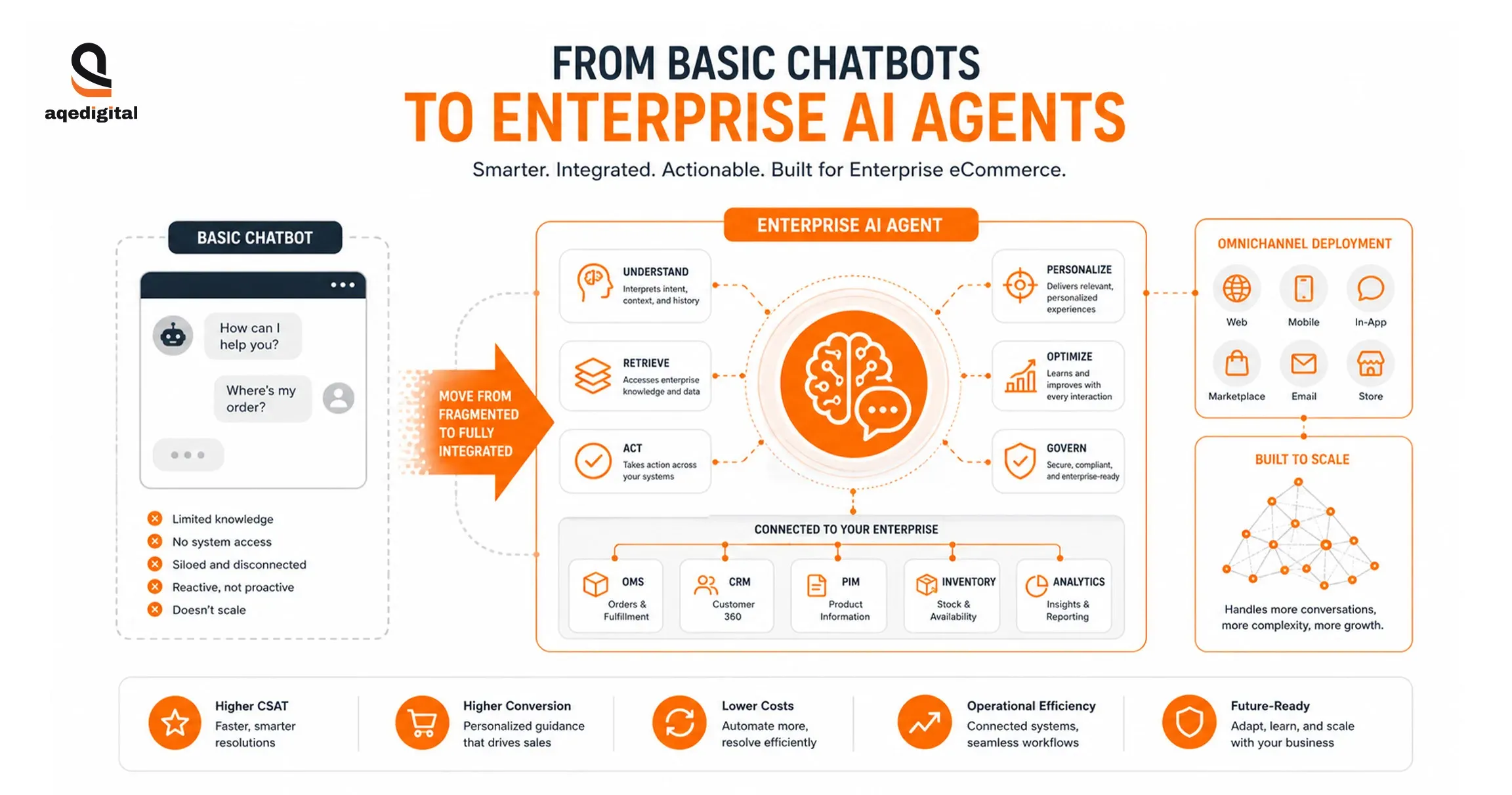
Basic Chatbots vs. Enterprise AI Agents:
- Integration: Basic bots operate in silos. Enterprise AI natively integrates with core stacks, including OMS, CRM, PIM, and inventory management.
- Scalability: Basic bots loop or fail during off-script queries. Enterprise AI handles thousands of concurrent sessions and learns from interaction data to refine recommendations.
- Deployment: Basic bots are often limited to a website widget. Enterprise AI supports true omnichannel deployment across web, mobile apps, WhatsApp, and in-store kiosks.
- Security: Enterprise AI operates strictly within corporate compliance and governance frameworks.
The Market Shift to AI Agents
The transition from basic bots to integrated AI is accelerating. According to Gartner, 40% of enterprise applications will feature task-specific AI agents by 2026, up from less than 5% in 2025. Retailers waiting for proof of concept risk losing their competitive advantage.
To align with this shift, AI-Based Services for the Retail Industry build enterprise-grade AI systems focused on specific operational outcomes rather than generic feature sets.
How Enterprise AI Chatbots Increase Sales and Conversions
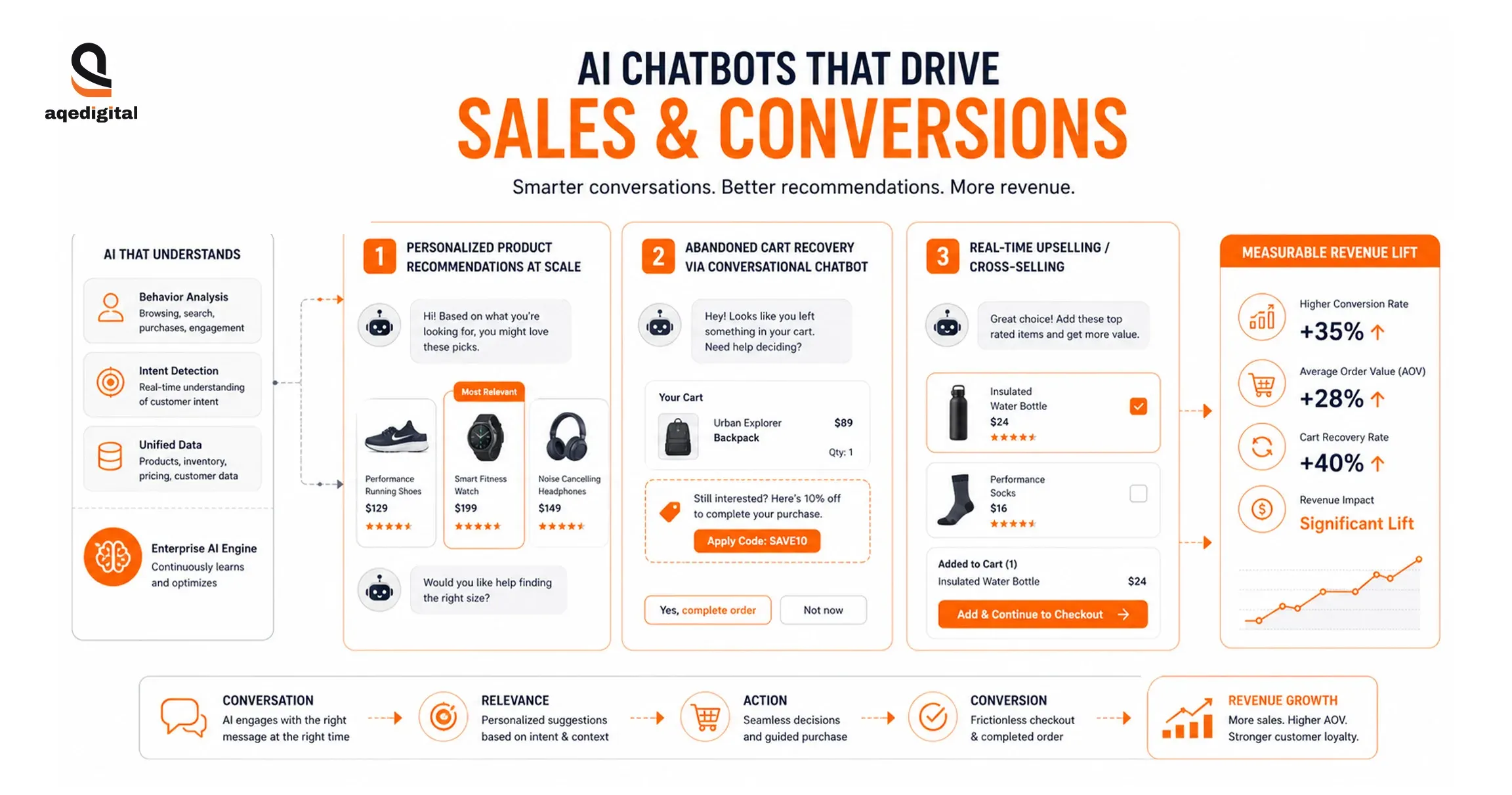
Revenue impact is where enterprise chatbot solutions separate from everything else. The mechanisms are specific, measurable, and compound over time.
1. Personalized Product Recommendations at Scale
Rule-based recommendation engines surface what sold last week. Enterprise AI goes further. The chatbot analyzes session behavior, purchase history, browsing pattern, and stated intent within the current conversation to surface products the buyer actually wants.
Returning shoppers who interact with an AI chat assistant spend 25% more per order. At scale, that average order value (AOV) lift translates directly to the P&L.
2. Abandoned Cart Recovery via Conversational Chatbot for Ecommerce
Cart abandonment is a recoverable problem. A conversational chatbot for eCommerce proactively re-engages browsers who indicate they intend to exit. It surfaces objection-handling copy, offers time-sensitive incentives, or simply answers the blocking question.
It outperforms email recovery sequences, which typically convert at 4-8% with the best-performing templates.
3. Real-Time Upselling and Cross-Selling
Most upsell logic in basic chatbots is static. Enterprise AI reads the live context of a conversation and introduces complementary products at the natural decision point, not at a fixed point in a script.
When a buyer confirms a laptop purchase, the chatbot identifies the specific model, checks accessory compatibility, and surfaces a relevant protection plan or peripheral before checkout. Companies deploying AI chatbots across their eCommerce stack report revenue increases in the first year of production use.

Enterprise Chatbot Solutions for Customer Support Efficiency
Customer support is where enterprise chatbot solutions deliver their most immediate cost impact.
1. 24/7 Multilingual Support Without Headcount Growth
Enterprise retailers operating across geographies cannot scale human support to match global demand at acceptable unit economics. AI assistants for eCommerce operate continuously across time zones and natively support 50 or more languages.
Resolution time falls from over an hour to under 2 minutes for tier-1 queries. That headcount relief alone justifies the deployment cost in the first quarter.
2. Integration with CRM, OMS, and Support Platforms
Support AI fails when it operates in isolation. An enterprise AI chatbot connects to your CRM to surface customer history, your OMS to pull live order status, and your ticketing platform so that escalated issues arrive with the full conversation thread attached.
The human agent who picks up the escalation knows exactly what was asked, what was answered, and what remains unresolved.
Key Features of the Best eCommerce Chatbots
Not all chatbot platforms are comparable. When evaluating the best eCommerce chatbots for enterprise deployment, the feature delta between basic and enterprise-grade systems is substantial. The table below compares the two categories across the capabilities that matter for production use.
| Enterprise AI Chatbot vs Basic Chatbot Key Differences Overview | ||
| Feature | Enterprise AI Chatbot | Basic Chatbot |
| NLP-Powered Intent Recognition | Yes | Limited |
| Omnichannel (web, app, WhatsApp) | Yes | Rarely |
| CRM and OMS Integration | Native | Manual/API |
| Multilingual Support | Yes (50+ languages) | English only |
| Cart Recovery Automation | Yes | No |
| Personalized Product Recommendations | AI-driven | Rule-based |
| Human Handoff with Context | Yes | Basic |
| Sentiment Analysis | Yes | No |
| Analytics and Reporting Dashboard | Advanced | Basic |
The gap is not cosmetic. Missing NLP intent recognition means the bot fails on any non-standard query. Missing CRM integration means agents start every escalated call with no context.
Missing sentiment analysis means you lose sight of which conversations are at risk of churn. AI assistants for eCommerce at the enterprise grade include all of these capabilities as a baseline, not as premium add-ons.
AQe Digital's approach to Online Retail Solutions builds these capabilities into a cohesive architecture rather than stitching together disconnected tools.
What to Consider While Looking for an Enterprise AI Chatbot for eCommerce?
Selecting a vendor solution is far from being solely about feature comparison. In order to make the right choice, a large retail company should focus on certain operational criteria
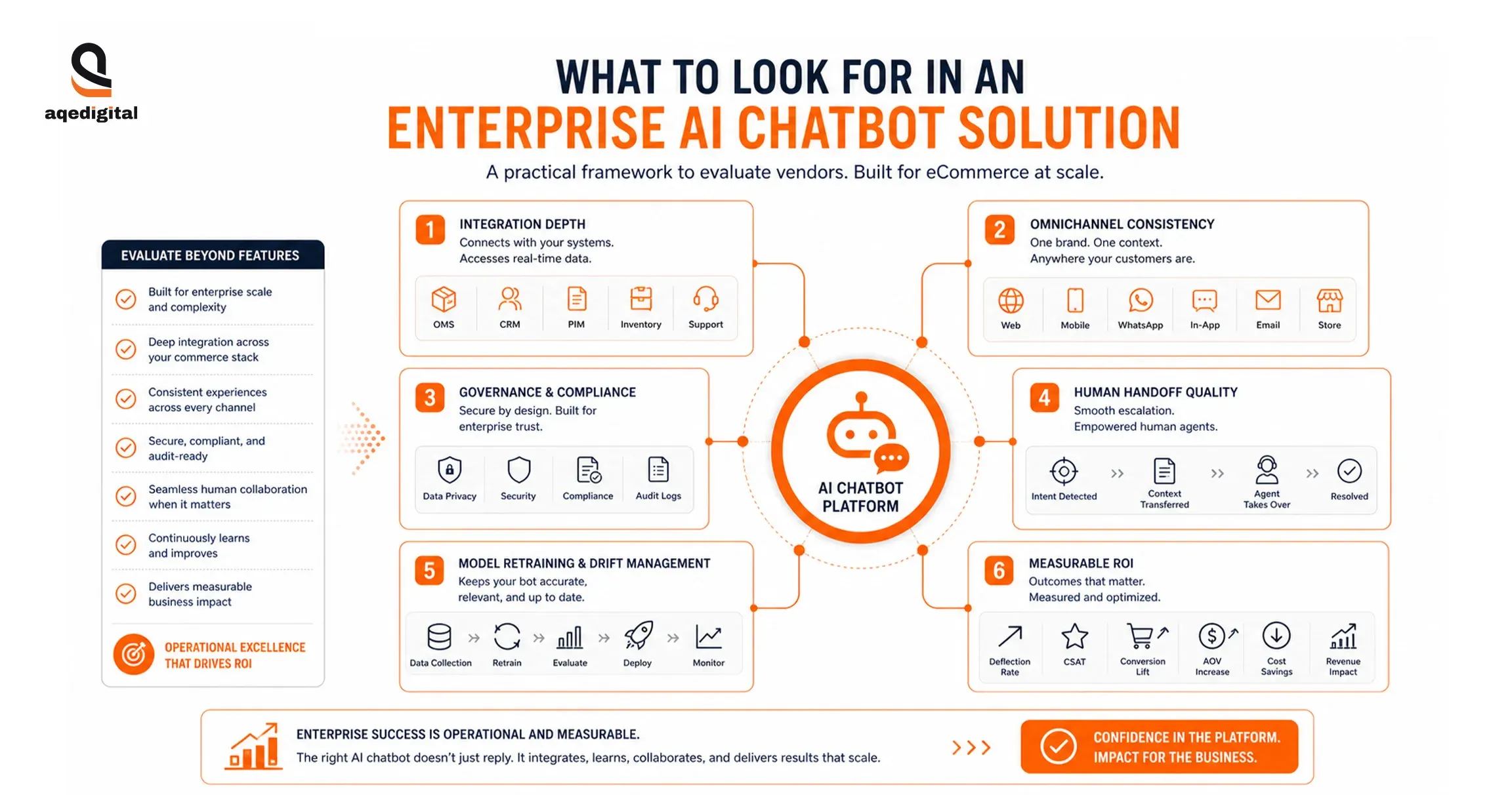
1. Native Integrations vs. Custom APIs
A chatbot, which natively integrates with the OMS, CRM, PIM, and customer service tools you use, will outperform a competitor in the same category but with a need to develop custom API for each system. Request vendors to show you the data extraction from your stack and not a sandbox demo.
2. Contextual Conversations Across Channels
Retail buyers switch from social media platforms, where they initiate conversations, to websites where they can purchase products. They do the same when contacting customer support services or switching between devices. A chatbot has to remember and transfer the conversation context between channels and not lose track of what was said previously.
3. Compliance and Data Governance Controls
Large companies require certain compliance capabilities when deploying AI-powered solutions. You may need role-based permissions for accessing the chat logs, data storage controls, and other important features. An enterprise AI chatbot has to offer them out-of-the-box while a small business tool will require custom development.
4. Escalation Quality
The ability of an AI chatbot to answer customer inquiries is limited. What is equally important is the quality of escalations to human agents. It needs to transfer the entire conversation history, highlight key sentiments, and explain any open queries.
5. ModelMaintenance Retraining and Maintenanc
Over time, your chatbot becomes less relevant as new promotions come up, your product catalog expands, and return policy gets updated. A good solution should be able to automatically train the underlying models in order to maintain accuracy and relevance.
6. Measurable ROI Framework
Demand a defined measurement framework before deployment. Deflection rate, cart recovery rate, AOV lift, CSAT delta, and cost per resolution are the metrics that matter. An average ROI of 5.8x on AI investments within 14 months of production deployment.
That benchmark is achievable when success metrics are defined upfront and tracked rigorously. For context on how AI drives measurable commercial outcomes in retail, see "Predictive Analytics in Retail."
 Conclusion
The revenue case for an AI chatbot for eCommerce is no longer theoretical. The question for enterprise eCommerce teams is not whether to deploy, but whether to build on infrastructure that will perform at scale in two years
Enterprise chatbot solutions that integrate deeply, train continuously, and measure outcomes rigorously deliver compounding returns.
Basic bots do not. The enterprise AI chatbot solution for eCommerce you deploy today shapes buyer experience, support efficiency, and revenue trajectory for the next several years. Choose infrastructure that scales with the complexity of your operation, not around it.